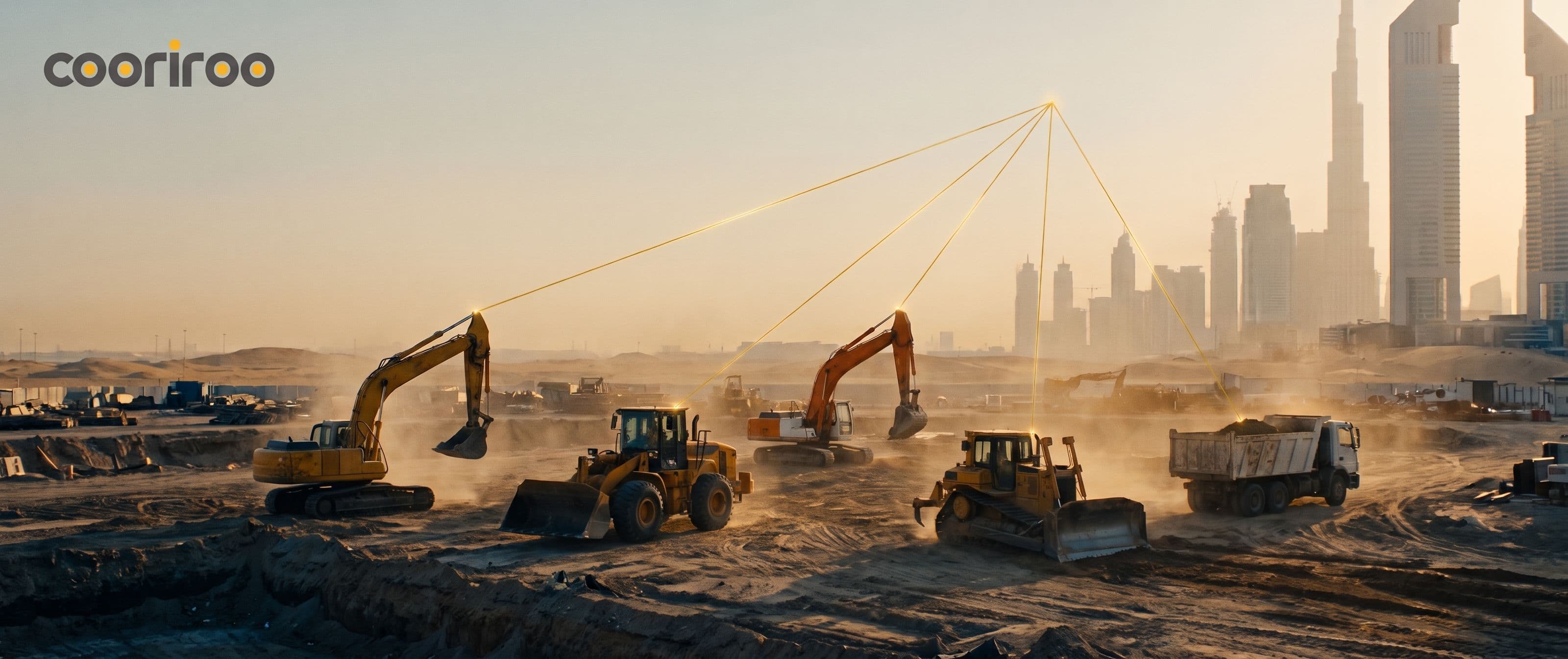
7 Heavy Equipment Fleet Management Trends You Should Know in 2027
Managing heavy equipment is no longer just about knowing where your machines are. It is about understanding what they are doing, how much they cost your business and whether you are getting enough value from them.
Over the past few years, we have seen significant changes in fleet management. GPS tracking has become common, telematics technology has improved, and artificial intelligence has introduced new ways of working with operational data.
Yet many construction, mining and equipment rental companies still face the same everyday problems.
One machine is sitting idle while another site is renting similar equipment. Maintenance teams are working with spreadsheets. Operators are sending inspection photos through WhatsApp. Managers are switching between different systems simply to understand what happened during the day.
The technology exists, but the information is still disconnected.
We believe 2027 will be less about collecting more data and more about connecting the data businesses already have.
Here are seven heavy equipment fleet management trends we expect to shape the industry in 2027.
1. Mixed-Fleet Telematics: One Platform Instead of Multiple Systems
Most heavy equipment fleets consist of machines from different manufacturers. Some are owned, others are rented, and some have been in operation for many years.
Managing each brand through a separate telematics portal creates unnecessary complexity.
Imagine a construction company operating excavators, loaders, cranes and bulldozers from five different manufacturers across multiple project sites. Its operations manager should not need five different systems to understand equipment availability.
This is where mixed-fleet telematics becomes increasingly important.
Standards such as ISO 15143-3, commonly associated with AEMP 2.0, help fleet management platforms access standardized machine data from participating equipment manufacturers.
Depending on the manufacturer and available integrations, this can include:
Equipment location
Engine operating hours
Fuel consumption
Idle time
Machine health and fault information
In 2027, we expect businesses to place greater importance on how well their existing systems communicate with each other.
The goal should not be to replace every technology a company already uses. It should be to bring relevant information together in one operational environment.
2. Equipment Data Is Becoming More Accessible
For years, accessing machine-generated data has largely depended on equipment manufacturers and their proprietary systems.
This is beginning to change.
The EU Data Act, which became applicable in September 2025, introduced new rights concerning access to data generated by connected products, including industrial equipment, subject to its applicable conditions.
For European construction and heavy equipment companies, this creates new opportunities to integrate machine data into independent fleet management and maintenance platforms.
Although the regulation does not directly apply to businesses operating exclusively outside its territorial scope, developments in Europe may influence how global equipment manufacturers approach data accessibility in markets such as the UAE and Saudi Arabia.
Greater access to equipment data could give businesses more flexibility when selecting software, maintenance providers and technology partners.
3. Equipment Utilization Will Matter More Than GPS Tracking
A machine can be visible on a map and still be losing money.
Traditional fleet tracking answers an important question: Where is my equipment?
But businesses also need answers to questions such as:
- How often is this machine being used?
- How much time does it spend idling?
- Do we really need to rent additional equipment?
- Could an existing machine be transferred to another project?
- Which assets are costing us more than they contribute?
Equipment utilization will become an increasingly important performance indicator in 2027.
For example, a construction company may continue renting an excavator for one project while an owned excavator remains underutilized at another location.
The problem is not necessarily a shortage of equipment. It may simply be a shortage of visibility.
By combining equipment location, operating hours, idle time and project information, businesses can make better decisions about their existing assets before investing in new ones.
How to Measure Heavy Equipment Utilization
Two useful indicators for monitoring equipment performance are:
Engine-hour utilization (%) = (Engine operating hours / Available working hours) × 100
Idle ratio (%) = (Idle hours / Engine operating hours) × 100
Engine-hour utilization alone does not measure productive work, which is why idle time and actual job output should also be considered.
Tracking these indicators consistently can help businesses identify underused assets, reduce unnecessary fuel consumption and improve equipment allocation across project sites.
Sometimes the most valuable machine is the one you already own but are not using effectively.
4. Predictive Maintenance: Moving Beyond Scheduled Servicing
Unexpected equipment breakdowns rarely affect just one machine.
They can delay an entire construction project, leave employees waiting, increase rental expenses and create additional costs that are difficult to recover.
This is why predictive maintenance continues to attract attention in heavy equipment fleet management.
However, predictive maintenance is not something that happens simply because a company starts using AI.
Reliable predictions require consistent, high-quality historical data, including machine operating hours, maintenance records, fault information and equipment condition.
For many businesses, the most practical starting point is usage-based maintenance, alongside manufacturer-recommended calendar-based servicing.
Maintenance teams can use actual engine hours, where available, to determine when equipment requires servicing.
A more connected maintenance process can include:
- Service reminders based on operating hours
- Automated maintenance work orders
- Equipment inspection records
- Fault alerts from supported telematics systems
- Historical maintenance and repair information
As businesses collect more reliable operational data, AI can help identify recurring problems and support more informed maintenance decisions.
The objective is not simply to repair equipment faster. It is to reduce avoidable interruptions before they affect the business.
5. Smartphones Will Become a Bigger Part of Heavy Equipment Operations
One of the biggest gaps in traditional equipment telematics is the human side of operations.
Machine data can tell us how long an engine has been running. But it does not necessarily tell us who was operating the machine, whether the safety inspection was completed or what happened during a particular shift.
This information comes from people.
Smartphone-based operational tools can help connect operators, field teams, maintenance staff and fleet managers without requiring additional in-vehicle hardware for these workflows.
Operators can use their phones to:
- Complete daily equipment inspections
- Report damage with photos
- Record shift and job information
- Submit maintenance requests
- Receive operational instructions
- Report completed tasks
It is important to understand that smartphones do not replace every function of traditional equipment telematics.
Engine hours, fuel consumption and unattended equipment tracking still require appropriate machine data sources.
The real opportunity is to combine machine data with information from the people working around the machines.
This gives businesses a more complete understanding of their operations without introducing unnecessary hardware for people-based workflows.
6. AI Fleet Management: From Dashboards to Actual Answers
For years, fleet management software has focused on dashboards, charts and reports.
But how many dashboards does an operations manager really need?
When managing hundreds of assets across different locations, finding the right information can be more time-consuming than collecting it.
Artificial intelligence is beginning to change this.
Instead of manually reviewing multiple reports, managers could ask questions in everyday language:
Which machines were underutilized last week?
Which excavators had the highest idle ratio?
Which equipment is approaching its next service interval?
Which sites may have equipment available for reassignment?
What were our main operational cost drivers this month?
An AI-powered fleet management platform can help answer these questions using available operational data.
The important difference is that managers should be able to understand the information behind each answer rather than relying on an unexplained AI recommendation.
We do not expect AI to replace experienced fleet managers. We expect it to give them more time to manage their operations instead of searching for information.
7. Fleet Management ROI Will Become More Important Than Feature Lists
When selecting heavy equipment fleet management software, it is easy to compare features.
But having more features does not necessarily mean having a better solution.
The real question is whether the software helps the business reduce costs, improve equipment utilization and make better operational decisions.
In 2027, we expect more companies to evaluate fleet management ROI through measurable business outcomes, including:
- Lower fuel consumption
- Reduced equipment idle time
- Fewer unexpected breakdowns
- Lower equipment rental expenses
- Better utilization of existing assets
- Reduced administrative workload
How to Calculate Fleet Management ROI
Businesses can start by measuring three major sources of operational costs.
Idle fuel cost = Monthly idle hours × Fuel consumed per idle hour × Fuel price
Rental savings = Avoided rental days × Daily rental rate
Downtime cost = Unplanned downtime hours × Estimated operational cost per hour
These indicators can help businesses estimate the financial impact of better fleet management.
To calculate the overall return on investment:
ROI (%) = ((Financial benefits − Total solution costs) / Total solution costs) × 100
Before implementing a new fleet management solution, businesses should establish a baseline using their existing operational data.
Comparing these results three months after implementation, while accounting for changes in workload and operating conditions, provides a much more meaningful picture of the software's value than comparing feature lists alone.
Why Heavy Equipment Fleet Management Needs More Than Telematics
The future of fleet management is not just about vehicles or machines.
It is about the relationship between equipment, people, projects, maintenance and business costs.
Consider a construction company operating across several sites.
Its equipment data may be available in manufacturer portals. Its employees may communicate through WhatsApp. Maintenance records may be stored in Excel, while project costs are managed in an ERP system.
Each system serves a purpose, but none necessarily provides the complete operational picture.
This is where the industry needs to move beyond traditional fleet management software.
Connecting these different areas can help businesses understand not only what is happening with their equipment, but also how equipment-related decisions affect the wider organization.
This is particularly relevant for construction, mining and equipment rental companies operating across the UAE, Saudi Arabia and the wider GCC region, where managing distributed assets and field teams can create additional operational complexity.
How Cooriroo Approaches the Future of Fleet Management
At Cooriroo, we believe fleet management should be part of a connected operational environment rather than another isolated software system.
Cooriroo is an AI Operations Platform designed to bring fleet and asset management, workforce operations, maintenance, field activities and business processes together.
Our approach focuses on connecting available operational data, integrating existing systems where supported and simplifying everyday workflows for employees and managers.
Businesses can combine existing equipment data with smartphone-based field workflows, without introducing unnecessary hardware for activities that can be managed through mobile applications.
Cooriroo brings together operational areas such as:
- Fleet and asset management
- Workforce management
- Maintenance management
- Field service management
- Logistics and delivery
- CRM and ERP
AI-powered operational assistants
Behind Cooriroo is an engineering team with enterprise integration experience, focused on helping organizations connect their existing technologies rather than unnecessarily replacing them.
Whether you manage construction equipment, rental assets or a distributed fleet across multiple operational sites, our objective remains the same: to help you understand your operations and make better decisions.
Is Your Heavy Equipment Fleet Ready for 2027?
Before investing in another fleet management solution, consider these questions:
Can you see all your equipment in one operational view?
Do you know which machines are underutilized?
Can your maintenance team access reliable equipment information?
Are operators still reporting inspections through paper forms or messaging apps?
Can you measure the financial impact of equipment downtime?
Can your existing systems communicate with each other?
Are you using AI to solve operational problems or simply adding another technology?
If several of these questions remain unanswered, there may be an opportunity to improve your operations without immediately investing in more equipment.
Final Thoughts
The next stage of heavy equipment fleet management will not be defined by the number of GPS devices installed or the number of dashboards available.
It will be defined by how effectively businesses connect their assets, people and operational data.
From mixed-fleet telematics and predictive maintenance to smartphone-based workflows and AI-powered decision support, the technologies shaping 2027 are creating new opportunities for construction, mining and equipment rental companies.
But technology alone is not the answer.
The real value comes from turning information into better everyday decisions.
Ready to take a more connected approach to heavy equipment fleet management?
Discover how Cooriroo can help your business connect its equipment, people and operations through one AI Operations Platform.
Frequently Asked Questions
What are the biggest heavy equipment fleet management trends for 2027?
The key trends include mixed-fleet telematics, greater equipment data accessibility, improved equipment utilization, predictive maintenance, smartphone-based operator workflows, AI-powered decision support and measurable fleet management ROI.
What is the best fleet management software for heavy equipment?
The best solution depends on your fleet composition, operational requirements and existing systems. Businesses should evaluate mixed-fleet integration capabilities, maintenance management, operator workflows, reporting and compatibility with their available equipment data.
How is AI used in heavy equipment fleet management?
AI can help analyze operational data, identify utilization patterns, support maintenance planning, automate reporting and answer fleet-related questions in natural language. Its effectiveness depends on the quality and availability of underlying data.
What is mixed-fleet telematics?
Mixed-fleet telematics brings equipment data from different manufacturers into a common management environment. Standards such as ISO 15143-3, commonly associated with AEMP 2.0, can support data exchange between compatible telematics providers and fleet management platforms.
Can smartphones replace traditional heavy equipment telematics?
Smartphones can support operator tracking, inspections, task management and field reporting without additional vehicle hardware. However, they cannot directly measure engine hours, fuel consumption or reliably track unattended equipment without appropriate machine data sources.
How can construction companies improve equipment utilization?
Construction companies can improve equipment utilization by monitoring operating hours, identifying underused assets, reducing unnecessary idle time and reallocating equipment between project sites based on operational demand.
How do you calculate fleet management ROI?
Fleet management ROI is calculated by subtracting total solution costs from measurable financial benefits, dividing the result by total solution costs and multiplying by 100. Financial benefits may include fuel savings, reduced rental expenses, lower downtime costs and reduced administrative workload.
What is a good utilization rate for heavy equipment?
There is no universal equipment utilization target. An appropriate rate depends on the machine type, project requirements, operating conditions and seasonal demand. Companies should establish their own performance baseline and compare similar equipment under similar working conditions.
Is predictive maintenance practical for heavy equipment?
Yes, when sufficient and reliable equipment data is available. Companies can begin with usage-based maintenance, digital inspections and fault alerts before implementing more advanced predictive maintenance capabilities.
How can heavy equipment fleet management software help companies in the UAE and Saudi Arabia?
Fleet management software can help companies improve equipment visibility across multiple project sites, coordinate field teams, monitor maintenance requirements and identify opportunities to reduce operational costs. The benefits depend on available data, system integrations and operational workflows.