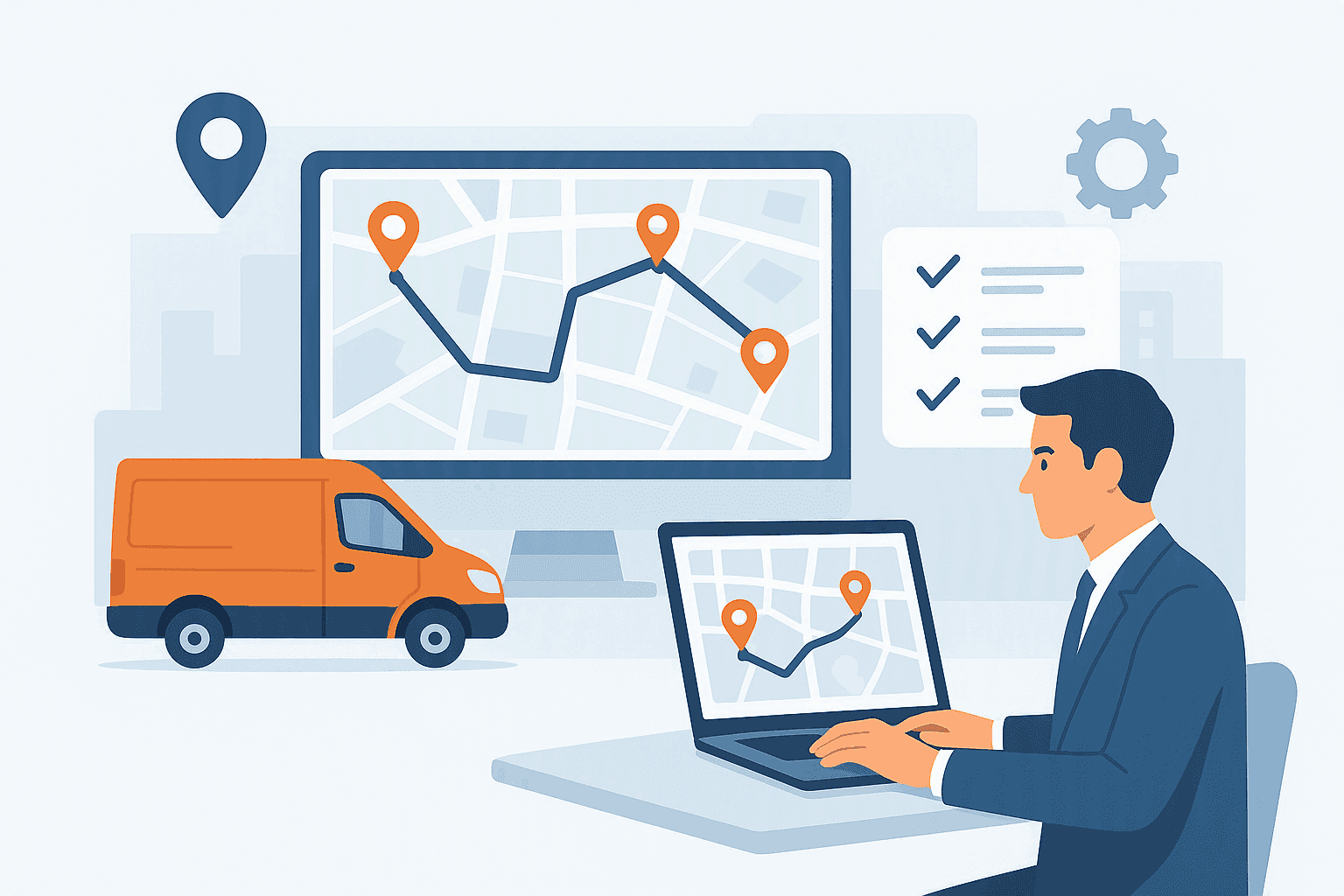
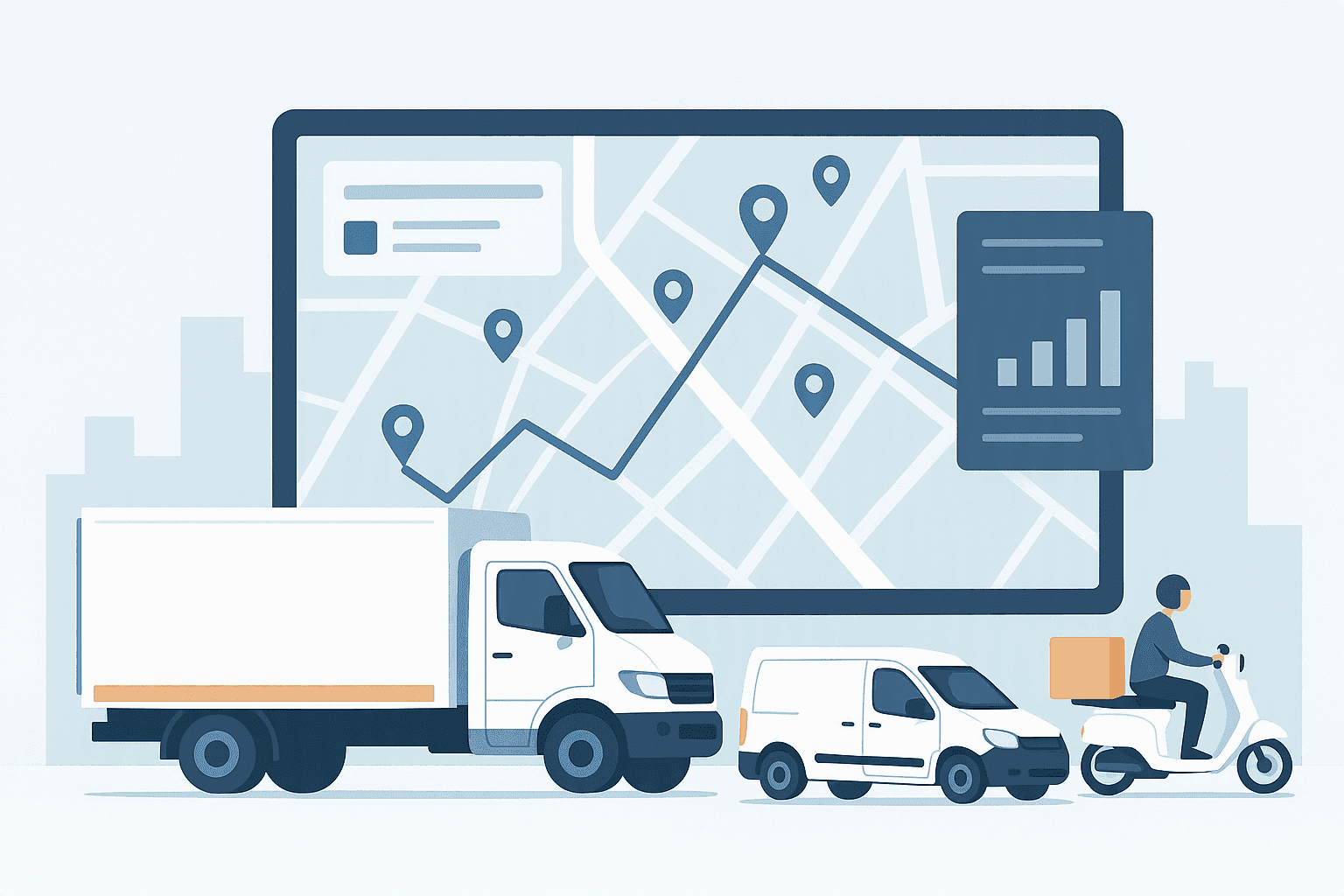
Why Waste Collection Needs More Than Fleet Tracking
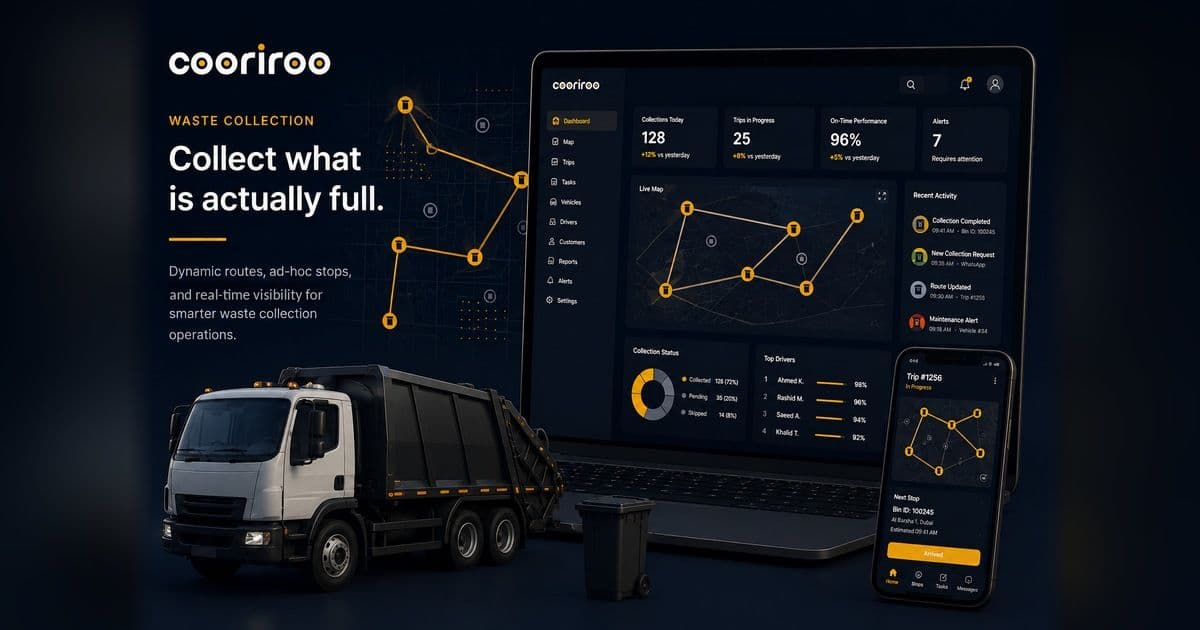
Why Waste Collection Needs More Than Fleet Tracking
Cooriroo works with fleet and waste operators across the UAE, Saudi Arabia, and other markets where collection operations are complex and constantly changing. Across these operations, the same challenges come up again and again.
Interestingly, they are rarely about knowing where a truck is.
Most operators already have visibility into vehicle location. The harder problem is what happens next: how to turn that information into better routes, faster decisions, better workforce coordination, lower operating costs, and a reliable record of what actually happened in the field.
That is where fleet tracking alone starts to fall short.
Fixed Waste Collection Routes Create Hidden Costs
This is one of the most common challenges in waste collection. Someone designed the collection rounds when a contract started. They worked reasonably well at the time, so they stayed in place.
Years later, the same rounds are still being driven.
The cost is difficult to see because it is spread across every working day. A crew may empty bins that are only a third full. A container that overflowed on Tuesday may not be collected until Friday because that is when the street is scheduled.
Neither situation necessarily produces a report. Both consume fuel, working hours, and eventually lead to customer complaints.
Waste generation is not evenly distributed, and it does not remain constant. A commercial area can have very different collection patterns in July compared with January. A construction site may generate almost nothing for weeks and then require several collections in a matter of days.
A fixed collection round cannot respond to these changes. It was optimized once, based on an expected pattern that may no longer reflect reality.
From Fixed Routes to Dynamic Route Optimization
This is where AI-powered route optimization becomes useful.
In Cooriroo, routing is not limited to creating a route once and leaving it unchanged. Collection requirements, vehicle availability, and operational conditions can be used to build and adjust rounds as circumstances change.
The result is a shift from static route planning to a more responsive operation.
The objective is simple: send the right vehicle to the right locations in an efficient sequence, based on what actually needs to happen.
What Happens When a New Collection Request Comes In?
Every waste operator has a version of this problem.
A skip is full. A container has been illegally dumped. A commercial customer needs an unscheduled pickup. A collection request arrives after the day's routes have already started.
In a traditional workflow, this often means calling the driver, explaining the change, and figuring out where the new stop fits into the existing route.
That creates unnecessary mileage and puts additional pressure on the dispatcher and driver.
With Cooriroo, an additional stop can be added to an active trip and the route sequence can be recalculated. The driver does not have to finish the entire planned route before dealing with the new request, and the dispatcher does not have to manually rebuild the route.
The operation adapts to the change.
How Do You Prove a Waste Collection Happened?
For municipal and contracted waste operations, proving that a collection happened is not an administrative detail.
It can affect billing, contract compliance, customer disputes, and service-level reporting.
When a customer asks whether a collection took place, the answer should not depend on someone's memory of last Thursday.
Cooriroo records collection activity with operational data such as time and location and can capture photographic proof where required.
That creates a digital record of the work that was performed in the field.
For operators managing large numbers of collections, this changes the conversation from:
**"Did the crew collect it?"** to: **"Here is the record of when and where it was collected."**
How Much Does Each Waste Collection Round Cost?
Most operators know their overall fleet costs.
Far fewer have a clear view of what an individual collection round costs by vehicle, crew, route, or customer.
That distinction matters.
Without an accurate understanding of operational cost, pricing a new contract becomes difficult. An inefficient or unprofitable contract can also remain that way simply because the underlying cost is not visible.
Cooriroo connects operational activity with the information needed to understand the cost of running those operations.
This gives operators a more detailed view of the economics behind individual rounds and services rather than looking only at total monthly fleet expenditure.
---
Connect Waste Collection Operations With the Systems You Already Use
Most waste operators already have systems in place.
There may be an ERP handling finance and invoicing, a system holding customer and contract information, a CRM used by the commercial team, or other software managing parts of the business.
The last thing an operations team needs is another system that creates a second version of the same data.
Cooriroo is designed to connect with the systems already in use rather than forcing businesses to replace everything.
Operational records can be integrated with existing business systems, while customer and contract information can remain in the systems where it is already managed.
The objective is not to rebuild the technology stack.
It is to connect the operational layer to the rest of the business.
Where AI Fits Into Waste Collection Operations
AI can also extend beyond route optimization.
For example, enquiries arriving through WhatsApp can be handled and qualified automatically, with relevant information captured as part of the operational workflow rather than remaining inside an individual employee's phone.
This creates a connection between customer communication and the work that eventually needs to be performed.
AI is most useful when it is connected to the operation—not when it is simply another chatbot sitting beside it.
---
Why Hardware-Free Fleet Tracking Matters in Waste Collection
Waste collection fleets change frequently.
Vehicles can be leased for a specific contract, subcontracted during periods of higher demand, replaced when they fail, or moved between different operations.
Installing dedicated tracking hardware on every vehicle can therefore create an additional operational burden. Devices need to be installed, removed, maintained, and sometimes transferred to replacement vehicles.
Cooriroo uses the driver's smartphone for location and driving data, allowing tracking to follow the workforce rather than being permanently tied to a particular vehicle.
When a subcontracted or replacement vehicle joins the operation, there is no need to install a new tracking device before it can be used.
That can make a significant difference for fleets where vehicle composition changes frequently.
---
What a Connected Waste Collection Operation Looks Like
A modern waste operation should not depend on separate systems for every part of the process.
The workflow can instead connect:
- Collection requirements and customer requests
- Route planning and dynamic optimization
- Driver and vehicle assignment
- Real-time trip monitoring
- Ad-hoc collection requests
- Driver behaviour monitoring
- Digital proof of service
- Operational cost tracking
- Customer communication
- ERP and business-system integration
The important point is not the number of features.
It is the connection between them.
A collection request becomes a job. The job becomes a trip. The trip is assigned to a driver and vehicle. The route adapts when conditions change. The driver completes the work. The system records what happened. The resulting data can then be used by operations, finance, customer service, and management.
That is a very different proposition from simply knowing where the truck is.
---
Frequently Asked Questions About Waste Collection Software
Do we need to fit tracking devices to collection vehicles?
Not necessarily. Cooriroo can use the driver's smartphone to capture location, speed, and driving behaviour data. This can make it easier to bring subcontracted and replacement vehicles into the operation without installing dedicated tracking hardware.
Can Cooriroo handle municipal contracts and commercial clients together?
Yes. Municipal collection rounds and commercial, on-demand collections can be managed within the same operational platform. The workflows can be configured around the requirements of each type of service.
Can Cooriroo integrate with our existing ERP?
Cooriroo is designed to integrate with existing business systems rather than requiring operators to replace them. The specific integration depends on the ERP and the operational data that needs to be exchanged.
Can routes change after a collection operation has started?
Yes. Additional stops and operational changes can be incorporated into active trips, allowing routes to be recalculated rather than forcing dispatchers to manage changes manually.
Can Cooriroo track driver behaviour?
Yes. Driver behaviour data can be captured through the driver's smartphone, including events such as speeding, harsh braking, acceleration, and turning behaviour.
---
Ready to Improve Your Waste Collection Operations?
The question is not whether your fleet has GPS tracking.
The better question is what happens with the information once you have it.
Can your system turn a new collection request into an optimized trip? Can dispatchers adapt routes while vehicles are already in the field? Can you prove that a collection happened? Can you understand the cost of individual rounds? Can customer communication, workforce activity, and operational data exist in the same workflow?
If the answer to those questions is still spread across different systems, spreadsheets, phone calls, and individual employees, there may be an opportunity to simplify the operation.
**Cooriroo brings fleet, workforce, tasks, customer communication, routing, and operational data into one connected platform.**